
Plants, flowers & gardens
Automatic irrigation for a balcony or garden: why installation need not be expensive
23.10.2026
“Automatic irrigation” can bring to mind trenches, a large control cabinet and the budget of a public park. For a balcony with a few pots or a small garden, the starting point can be much simpler: an existing tap, a suitable timer, tubing and drippers. The task determines the scale. Planning helps you identify what you need and avoid buying equipment that adds little value.
Start with one corner
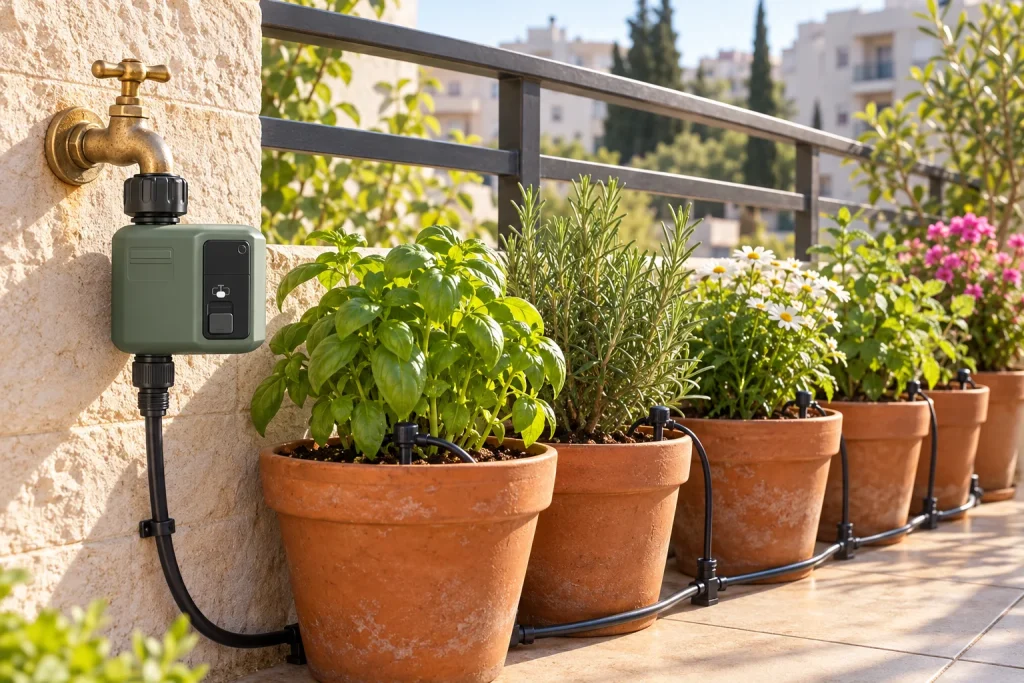
Imagine a row of planters beside a balcony tap. Instead of carrying a watering can along them each evening, a line can deliver water on a schedule. Where the route is short and accessible and no new water supply is needed, installation can be relatively modest. This is an example of the approach, not a fixed quotation or a promise that every balcony needs the same kit.
One group of plants may suit a single-outlet smart timer. Two groups needing different watering frequencies may call for two outlets, such as the HCT-636. The number of pots does not equal the number of outlets: plants with similar needs can share a line when emitter selection and available flow are appropriate.
What makes up the installation cost?
| Element | What we assess | What can increase the scope |
|---|---|---|
| Water supply | Tap position, connection, pressure and flow | A new supply point or repairs |
| Timer | Number of zones and programming method | Extra zones or a compatible gateway |
| Tubing and drippers | Route length, diameter and emitter flow | Long runs, height differences and dispersed planting |
| Connections | Fittings, filtration and pressure requirements | Adapting an existing installation |
| Labour | Installation, testing and demonstration | Difficult access or complex routing |
The timer price is only one part of the total. Ask for a breakdown of equipment, materials and labour, including what setup and testing cover. We agree the scope and cost before work begins. Our irrigation page shows equipment choices and seller links; the installed-system quotation depends on your site.
Save through planning
- Decide the zones before buying a controller. Four outlets offer little advantage if one line is enough.
- Check which parts of an existing system are in suitable condition to keep.
- Group plants with similar requirements instead of buying a timer for every pot.
- Choose phone control when it is useful to you. A conventional timer also automates watering.
- Check tubing, fittings and drippers for compatibility before ordering.
You can begin with one area and consider future expansion. Ask what the chosen equipment and water supply can support: expansion is not always as simple as adding another length of tubing.
What happens during installation?
First, the water point and route are checked. Plants are grouped, emitters and fittings selected, and tubing positioned so it does not obstruct walkways or container drainage. Filtration, pressure regulation and other connection components are chosen for the equipment and supply. The illustration in this article explains the concept; it is not a complete installation diagram.
Each line is then run to check delivery and leaks. An initial schedule is set and you are shown how to change it. There is no single correct duration for every garden: plants, growing medium, season and emitter flow all matter. Settings are reviewed after observing the first cycles.
Do you need an app or internet?
No. A conventional timer is programmed on its body. A compatible smart system can use Smart Life or Tuya as specified by its instructions. Remote control requires a working communication path and, for gateway-based kits, a compatible gateway. Read our guide to everyday convenience with app-controlled irrigation for practical examples.
Common questions before starting
Does it always involve digging? No. Accessible container lines may run along a wall or railing, while other garden layouts can require infrastructure work. Can you use equipment I already bought? We first check its model, condition and suitability. Does automation remove maintenance? No. Emitters, connections and batteries still need periodic checks.
What to send for an initial discussion
Send a wide photograph of the balcony or garden, photographs of the taps, an approximate pot count and the distances involved. Mention any existing system and whether you want phone control. This gives us a useful starting point and helps determine whether a visit is needed. We offer automatic irrigation planning and installation in Haifa, nearby areas and northern Israel; central and southern locations by arrangement.
For background on container drip irrigation, see Rain Bird’s guide. Its example is not a specification for the products in our catalogue.